Stem cell therapy in the US: the FDA rules and the new state laws
Evidence levelBy modalityFederal rules in 21 CFR Part 1271 sort human cell and tissue products: one that meets all four criteria in § 1271.10(a) is regulated solely under section 361 of the Public Health Service Act, and one that does not, and has no exception, is regulated as a drug, device or biological product (§ 1271.20). Since 2024 Utah, Florida and Wyoming have added statutes that set notice, consent and sourcing conditions for some stem cell therapies, and Montana’s rules for experimental treatment centers took effect on 25 July 2026.

The federal rules: section 361 or drug and biologic rules
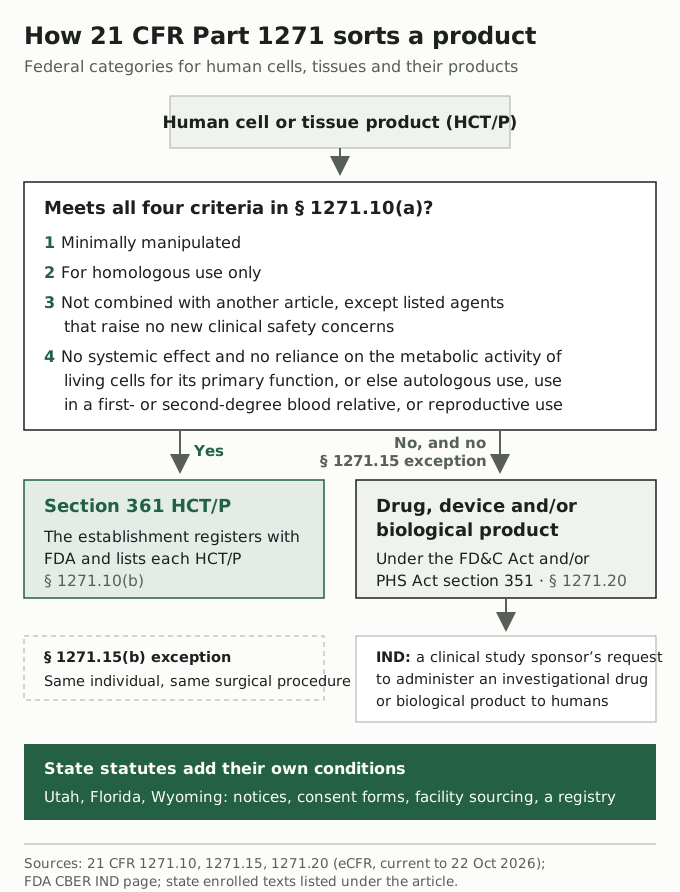
Under 21 CFR 1271.10(a), a human cell or tissue product (HCT/P) is regulated solely under section 361 and Part 1271 if it meets all four criteria: it is minimally manipulated; it is “intended for homologous use only”; it is not combined with another article, apart from water, crystalloids or a sterilizing, preserving or storage agent whose addition “does not raise new clinical safety concerns with respect to the HCT/P”; and either it has no systemic effect and does not depend on the metabolic activity of living cells for its primary function, or it does and is for autologous use, for a first- or second-degree blood relative, or for reproductive use. The establishment that makes it registers with FDA and lists each HCT/P (§ 1271.10(b)).
Section 1271.15(b) exempts from Part 1271 an establishment that removes cells or tissue from a person and implants them into the same person during the same surgical procedure. A product that fails a criterion and fits no exception “will be regulated as a drug, device, and/or biological product” (§ 1271.20). An FDA page for CBER-regulated products describes an investigational new drug application (IND) as a clinical study sponsor’s request “to administer an investigational drug or biological product to humans”; reading FDA records on stem cell products explains what that record shows.
State laws since 2024, record by record
Utah: Code § 58-1-512, stem cell disclosure
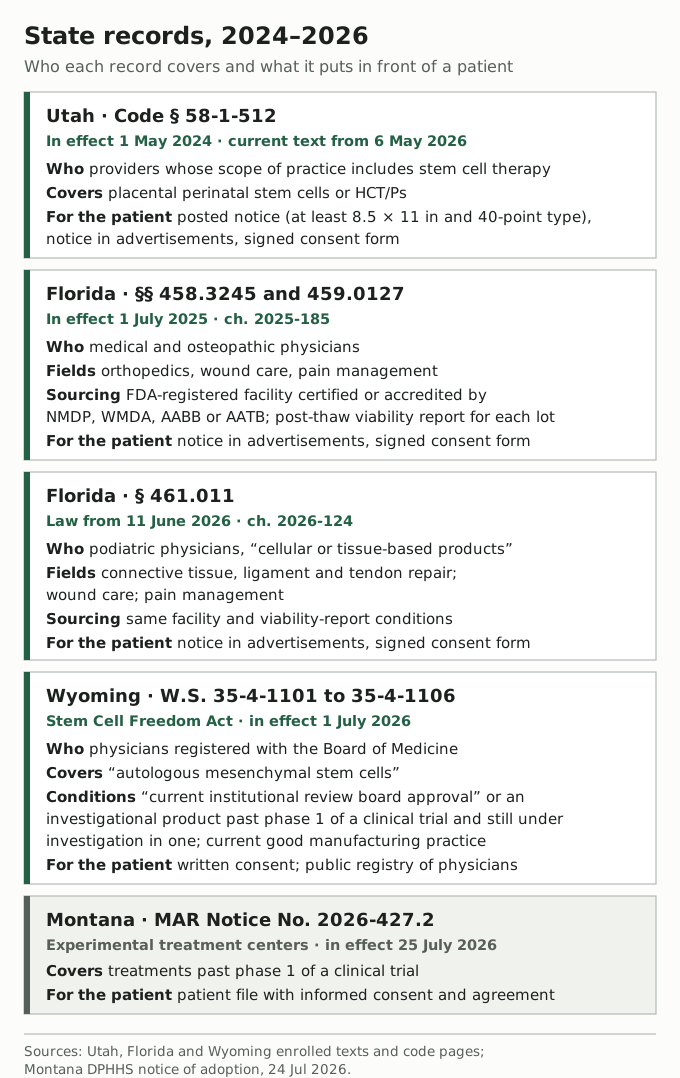
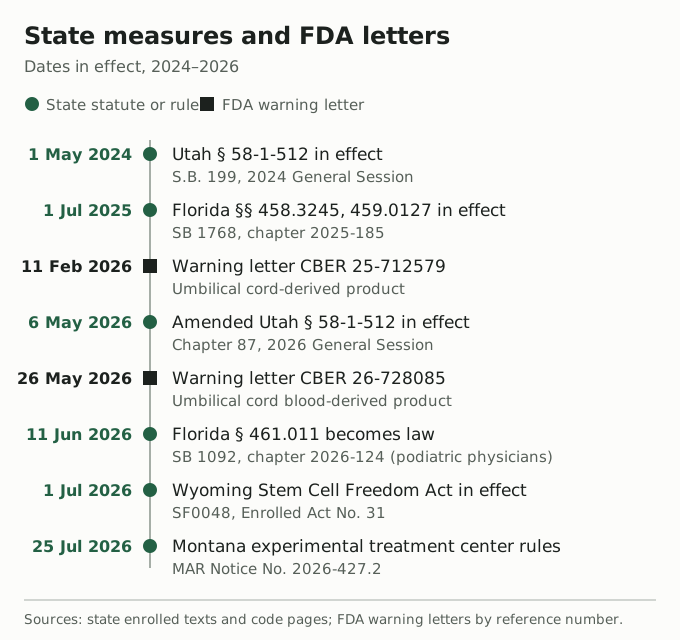
Utah enacted the section through S.B. 199, in effect from 1 May 2024; the current text took effect on 6 May 2026 (amended by chapter 87, 2026 General Session). It covers a health care provider whose scope of practice includes stem cell therapy, defined as treatment involving “afterbirth placental perinatal stem cells or human cells, tissues, or cellular or tissue-based products.” Before such a therapy the provider gives the patient a written notice that opens “THIS NOTICE MUST BE PROVIDED TO YOU UNDER UTAH LAW.” The notice is on paper at least 8.5 by 11 inches, in at least 40-point type, displayed at the entrance and where patients can see it, and repeated in any advertisement for the therapy.
The patient signs a consent form that states the nature of the treatment, including its “United States Food and Drug Administration approval status”, the anticipated results, the recognised alternatives, and the serious possible risks and anticipated benefits. The 2026 text adds a condition for suppliers: before supplying cells or tissue, they obtain the provider’s written confirmation that patients will receive the notice. The section does not apply to a provider “who has obtained approval for an investigational new drug or device” from FDA for these products, or to one working on behalf of an institution certified by the Foundation for the Accreditation of Cellular Therapy, the Blood and Marrow Transplant Clinical Trials Network, the Association for the Advancement of Blood and Biotherapies or another body the state division names.
Florida: sections 458.3245 and 459.0127 (2025) and 461.011 (2026)
SB 1768 (chapter 2025-185) took effect on 1 July 2025 and created parallel sections for medical and osteopathic physicians. They cover stem cell therapy within the physician’s scope of practice and “related to orthopedics, wound care, or pain management.” The cells must be retrieved, manufactured and stored in a facility registered and regulated by FDA and certified or accredited by the National Marrow Donor Program, the World Marrow Donor Association, the Association for the Advancement of Blood and Biotherapies or the American Association of Tissue Banks. Each lot needs a post-thaw viability report sent to the physician before use, and the supply contract requires the facility to give the physician its accreditation details. Advertisements carry a notice that opens “THIS NOTICE MUST BE PROVIDED TO YOU UNDER FLORIDA LAW,” and the patient signs a consent form with five required statements.
SB 1092 (chapter 2026-124) became law on 11 June 2026 and created section 461.011 for podiatric physicians. It uses the term “cellular or tissue-based products” and lists “connective tissue, ligament, and tendon repair; wound care; or pain management,” with the same facility, viability report, advertising notice and consent requirements.
Wyoming: the Stem Cell Freedom Act (2026)
Enrolled Act No. 31 (SF0048) created W.S. 35-4-1101 to 35-4-1106, effective 1 July 2026. It defines stem cell therapy as treatment involving “autologous mesenchymal stem cells,” including their cultural expansion. Its conditions: the therapy is “conducted in accordance with a current institutional review board approval” or is an investigational drug, biological product or device, a term whose definition in the Act requires completion of phase 1 of a clinical trial and that the product “remains under investigation in a clinical trial”; the cells are made under current good manufacturing practice; a physician-patient relationship exists; the physician is registered with the Wyoming Board of Medicine; and the patient gives written informed consent acknowledging four points, including the patient’s financial responsibility. The Act directs the Board to operate and publish a public registry of physicians registered under it.
Montana: experimental treatment centers (2026)
Montana’s Department of Public Health and Human Services adopted rules for “experimental treatment centers” in MAR Notice No. 2026-427.2, effective 25 July 2026. The notice quotes the state definition of experimental treatment in 50-12-102(1), MCA: a medical intervention “involving an investigational drug, biological product, device, or other treatment that has successfully completed phase 1 of a clinical trial.” It does not mention stem cells. Each center keeps a file for every patient that includes the treating practitioner’s documentation that the patient meets the criteria, informed consent under 50-12-105, MCA, and the patient agreement.
Enforcement and litigation in 2026
FDA’s Center for Biologics Evaluation and Research applied the § 1271.10(a) criteria in two 2026 warning letters about products derived from umbilical cord or cord blood: CBER 25-712579, dated 11 February 2026, and CBER 26-728085, dated 26 May 2026. The February letter states that the product fails the minimal manipulation criterion and the homologous use criterion; the May letter cites the homologous use criterion. Both state that the product is a drug and a biological product and is not regulated solely under section 361. Letters can be found by reference number in FDA’s warning letter search.
Private lawsuits are a second record. A 2026 analysis in Cytotherapy used a class action lawsuit as an example of patient-initiated lawsuits over unproven “stem cell” interventions, and discussed lessons for coordinated enforcement and litigation.
Records to ask for on each route
- Utah or Florida statute: the notice, posted or in the advertisement, and the signed consent form with the statements the section lists. In Florida, also the facility’s name, its certifying or accrediting body and the post-thaw viability report for the lot; the statute requires the facility to give these to the physician.
- Wyoming: the physician’s entry in the Board of Medicine registry, the review board or investigational record the therapy runs under, and the signed consent.
- Clinical study: the IND number and the trial registration; how to read a trial registration record covers the second.
- Montana experimental treatment center: the informed consent and the patient agreement, both kept in the center’s file for the patient.
- Any route: FDA’s warning letter search for the company named on the product.
How Korea handles the same question
Korea uses one national statute instead of a federal and state split. Its Act on the Safety of and Support for Advanced Regenerative Medicine and Advanced Biological Products, in the version marked [시행 2026. 10. 8.] [법률 제21525호, 2026. 4. 7., 타법개정], routes cell-based interventions through designated institutions and committee-reviewed research or treatment plans, and its definition of treatment recipients covers serious, rare and intractable diseases (Article 2(6)). Separate guides cover the 2026 Korean records and the 2026–2030 plan and the structure of Korean regenerative medicine law. For a visitor treated in Korea, the treatment record itself is one more document: what to ask a Korean clinic for before flying home.
Frequently asked questions
Which states added stem cell or experimental treatment measures in 2025 and 2026?
Florida created sections 458.3245 and 459.0127, in effect from 1 July 2025, and section 461.011 for podiatric physicians, law from 11 June 2026. Wyoming’s Stem Cell Freedom Act took effect on 1 July 2026. Utah amended section 58-1-512, first in effect in 2024, with the new text in effect from 6 May 2026. Montana’s rules for experimental treatment centers took effect on 25 July 2026.
What does the FDA test in 21 CFR 1271.10(a) check?
Four criteria: the product is minimally manipulated; it is intended for homologous use only; it is not combined with another article apart from water, crystalloids or a sterilizing, preserving or storage agent that raises no new clinical safety concerns; and it has no systemic effect and does not depend on the metabolic activity of living cells for its primary function, unless the use is autologous, in a first- or second-degree blood relative, or reproductive.
What is Wyoming’s stem cell registry?
The Stem Cell Freedom Act directs the Wyoming Board of Medicine to “operate and publish a public registry of qualified physicians registered to perform stem cell therapy.”
Primary sources
- 21 CFR Part 1271: Human cells, tissues, and cellular and tissue-based products (eCFR). Sections 1271.10, 1271.15 and 1271.20; eCFR current to 22 October 2026.
- FDA: Investigational New Drug Applications (INDs) for CBER-Regulated Products. What an IND is; content current as of 4 September 2026.
- Utah Code § 58-1-512, Stem cell disclosure (version in effect 6 May 2026). Notice, consent, advertising, supplier condition and exceptions.
- Utah S.B. 199, Placental Tissue Amendments, 2024 General Session (enrolled copy). Enactment of § 58-1-512 and its 1 May 2024 effective date.
- Florida Senate: CS/CS/SB 1768 (2025), Stem Cell Therapy, chapter 2025-185. Sections 458.3245 and 459.0127; effective 1 July 2025.
- Florida Senate: CS/CS/SB 1092 (2026), Podiatric Medicine, chapter 2026-124. Section 461.011; bill history and effective date.
- Wyoming Legislature: SF0048, Enrolled Act No. 31, Senate (2026 Budget Session). W.S. 35-4-1101 to 35-4-1106 and the Board of Medicine registry.
- Wyoming Legislative Service Office: summary of SF0048. Chapter 64 and the 1 July 2026 effective date.
- Montana Department of Public Health and Human Services: MAR Notice No. 2026-427.2, experimental treatment centers. Adopted rules, effective 25 July 2026, and the 50-12-102(1), MCA definition.
- FDA: Warning letters search. Letters CBER 25-712579 (11 February 2026) and CBER 26-728085 (26 May 2026).
- Korea: Act on the Safety of and Support for Advanced Regenerative Medicine and Advanced Biological Products. Version [시행 2026. 10. 8.] [법률 제21525호, 2026. 4. 7., 타법개정]; Article 2(6) definition of treatment recipients.
- Alonzo M, Grilley BJ, Weiss DJ, Ikonomou L. Litigating the hype: the Lung Health Institute class action and its implications. Cytotherapy. 2026;28(10):102902. PMID 42556174 · doi:10.1016/j.jcyt.2026.102902. Patient-initiated litigation.
Related guides: FDA status of stem cell and exosome treatment, the exosome product evidence checklist and safety and risks.