Stem cell therapy in South Korea in 2026: the records and the 2026–2030 plan
Evidence levelBy modalityThe treatment plan that Korea’s Ministry of Health and Welfare announced on 24 April 2026 as advanced regenerative medicine treatment No. 1 uses each patient’s own immune cells, not stem cells, for 15 people with a rare lymphoma. Stem cells appear in the 2026–2030 basic plan as government-led studies for knee osteoarthritis and intractable chronic pain, scheduled from July 2026 to March 2028.
Treatment No. 1: what the April 2026 record describes
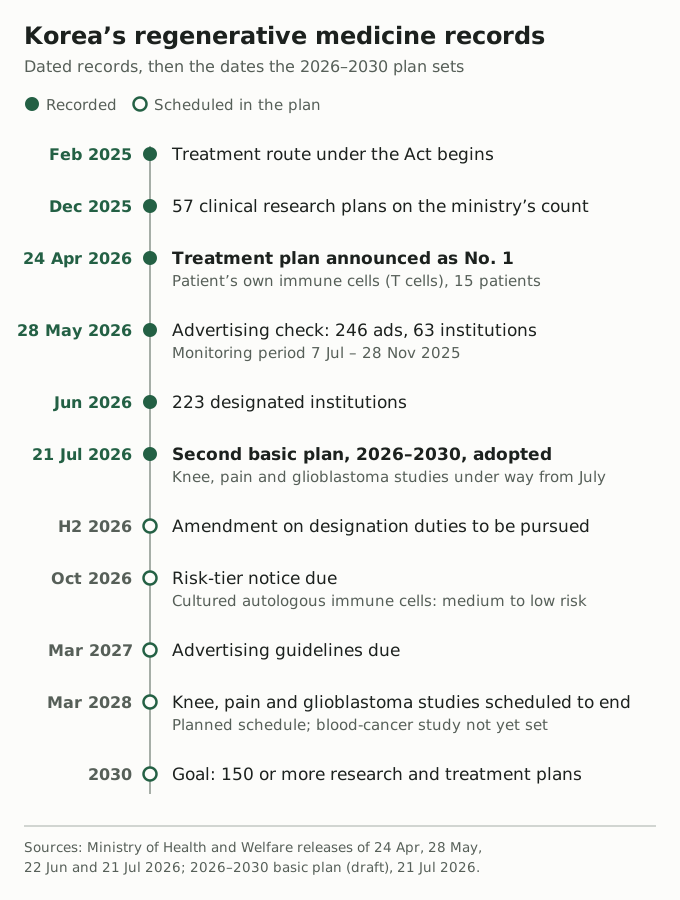
Korea’s advanced regenerative medicine statute has two routes for cell-based interventions: clinical research, and, since February 2025, treatment. On 24 April 2026 the ministry announced the first plan on the treatment route. It covers people with EBV-positive extranodal NK/T-cell lymphoma who are in complete remission after chemotherapy but at high risk of relapse. The plan uses T cells derived from each patient’s own body and directed at an Epstein–Barr virus antigen, scheduled as one intravenous dose a week for four weeks, four weeks off, then four more weekly doses: eight in all over 12 weeks. It covers 15 patients.
The ministry places the plan in the medium-risk tier. At that tier a treatment plan can be filed only after clinical research with the same purpose and content has been completed; this plan rests on a phase 2 trial run from 2017 to 2025 with 48 participants. A 2026 analysis of the amended Act in Stem Cell Reports sets out the rest of the design: patients pay for treatment, while clinical research carries cost prohibitions, and the risk tier decides whether completed research must come first. The Act defines the people the treatment route is for: those with a serious disease for which there is no alternative treatment or which threatens life, a rare disease under the Rare Disease Control Act, or another intractable disease (Article 2(6)).
The 2026–2030 basic plan in figures
On 21 July 2026 the government’s policy committee adopted the second basic plan for advanced regenerative medicine and advanced biological products, which the Act requires every five years (Article 5). The figures it reports:
- 57 clinical research plans on the ministry’s count to December 2025;
- 223 designated institutions in June 2026: 44 tertiary hospitals, 56 general hospitals, 39 hospitals and 84 clinics, according to the June designation release;
- a goal of 150 or more research and treatment plans in total by 2030.
The plan also adds duties for designated institutions: a research or treatment plan within one year of designation, with grounds to cancel the designation of those that file none, and renewal every three years. The ministry said the amendment to the Act for these duties would be pursued in the second half of 2026, with advertising guidelines for regenerative medicine due in March 2027. It also set October 2026 for a notice moving cultured autologous immune cells from medium to low risk; at low risk, a treatment plan can be filed without prior clinical research.
Where stem cells appear: four government-led studies
The plan answers demand for treatment abroad with research at home first. It names four diseases with high demand for treatment abroad and schedules government-led multicentre studies for each.
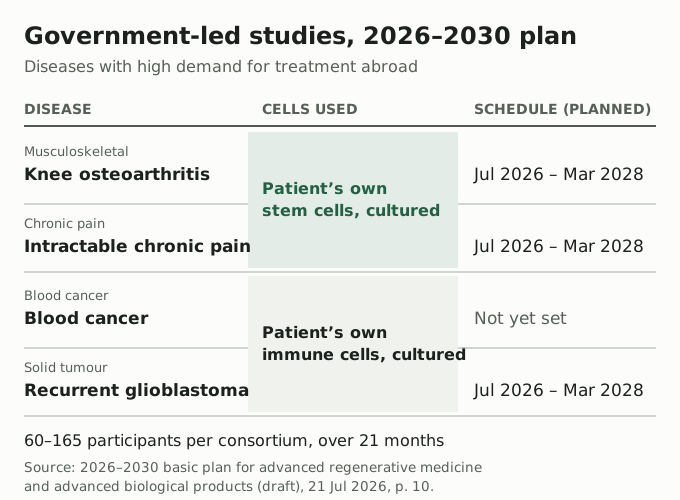
Two of the four use the patient’s own cultured stem cells: knee osteoarthritis and intractable chronic pain, both scheduled from July 2026 to March 2028. The blood cancer and recurrent glioblastoma studies use the patient’s own cultured immune cells. Each consortium plans for 60 to 165 participants over 21 months. According to the July release, the knee osteoarthritis, chronic pain and solid tumour (recurrent glioblastoma) studies were under way from July 2026, and the blood cancer study was due to be reviewed again that month with a revised protocol. The plan states that results will go to treatment-plan review, which weighs safety, efficacy and cost before treatment in Korea is decided.
Advertising: what the 2025 monitoring found
Between 7 July and 28 November 2025 the ministry checked blogs, YouTube, social media and websites for regenerative medicine advertising. On 28 May 2026 it reported 246 advertisements from 63 medical institutions to local governments for action. Of these, 236 (96%) came from 54 designated institutions, 36 of them clinics.
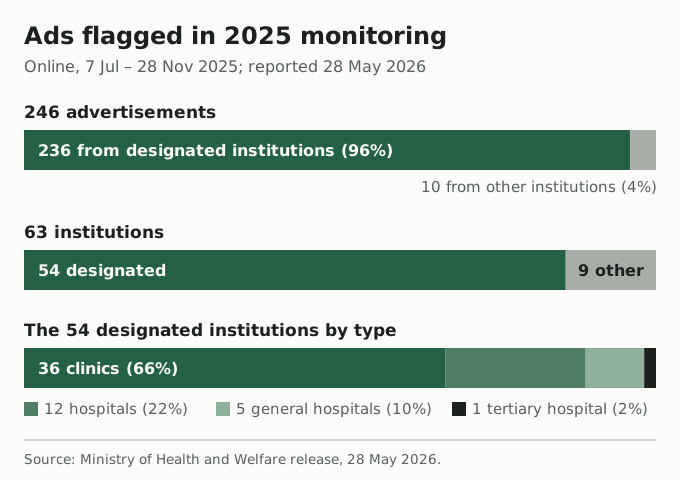
The main pattern was an institution citing its designation while promoting a procedure unrelated to advanced regenerative medicine as if it were regenerative medicine of verified safety. The ministry’s example is a knee osteoarthritis injection, a new health technology, advertised as regenerative medicine. The same release lists two separate requirements: the institution’s designation, and the committee’s review of the specific research or treatment plan. The advanced regenerative medicine portal publishes both. Which documents to ask a clinic for is set out in the guide to Korean regenerative medicine law and the questions to ask a clinic.
Research or treatment: what a visitor can plan around
Read together, the 2026 records sort into three groups. On the treatment route, the portal’s list of plans as of September 2026, posted on 6 October, has one entry: the April 2026 lymphoma plan. On the research route there are 57 plans counted to December 2025 and the government-led studies scheduled to March 2028. Advanced biological products, which the Act places under the Pharmaceutical Affairs Act, follow a separate product track.
Whether a proposed intervention belongs to a research plan, a treatment plan or neither is the first point to settle before planning travel. Consultation logistics, from directions to what to put in a request, are covered in a Seoul clinic’s planning notes for international patients. The United States sorts the same question by federal product rules and state statutes: see how US federal rules and state laws treat stem cell therapy.
Frequently asked questions
Which stem cell studies does Korea’s 2026–2030 plan schedule?
Government-led multicentre studies using the patient’s own cultured stem cells for knee osteoarthritis and intractable chronic pain, scheduled from July 2026 to March 2028, with 60 to 165 participants per consortium over 21 months.
Where are Korean regenerative medicine records published?
The ministry’s advanced regenerative medicine portal, k-arm.go.kr, lists designated institutions and the status of research and treatment plans. Ministry press releases report committee decisions with their dates.
What did Korea’s 2025 check of regenerative medicine advertising find?
Between 7 July and 28 November 2025 the ministry checked blogs, YouTube, social media and websites. On 28 May 2026 it reported 246 advertisements from 63 medical institutions to local governments for action; 236 came from 54 designated institutions.
Primary sources
- Ministry of Health and Welfare: press reference release on advanced regenerative medicine treatment No. 1 (24 April 2026). Disease, cell type, number of patients, risk tier and the prior phase 2 trial.
- Ministry of Health and Welfare: release on the second basic plan for advanced regenerative medicine and advanced biological products, 2026–2030 (21 July 2026). Research count, designation duties, risk-tier notice, government-led studies and the 2030 goal.
- Second basic plan for advanced regenerative medicine and advanced biological products, 2026–2030 (draft, 21 July 2026), with the release, posted by the KDI Economic Information and Education Center. Government-led study table, printed page 10.
- Ministry of Health and Welfare: results of 2025 online monitoring of regenerative medicine advertising (28 May 2026). Monitoring period, counts by institution type and the portal for public records.
- Ministry of Health and Welfare: 2026 call for designation of advanced regenerative medicine institutions (22 June 2026). Designated institutions by type, June 2026.
- Korean Act on the Safety of and Support for Advanced Regenerative Medicine and Advanced Biological Products. National Law Information Center text, version [시행 2026. 10. 8.] [법률 제21525호, 2026. 4. 7., 타법개정]; Article 2 definitions, Article 3 and Article 5 basic plan.
- Advanced regenerative medicine portal (첨단재생의료포털). Designated institutions and research and treatment plan records.
- Advanced regenerative medicine portal: list of research and treatment plans as of September 2026 (posted 6 October 2026). Treatment plan table.
- Yoon J, Lee S, Kim JH. New legal category of ‘advanced regenerative medicine treatment’ in Korea’s amended regenerative medicine law: comparative lessons from Japan. Stem Cell Reports. 2026;21(4):102852. PMID 41825446 · doi:10.1016/j.stemcr.2026.102852. Treatment route, payment and risk tiers.
Related guides: how Korean law regulates regenerative medicine, reading a clinical trial registration and safety and risks.