Exosome therapy in 2026: what is sold and what the records show
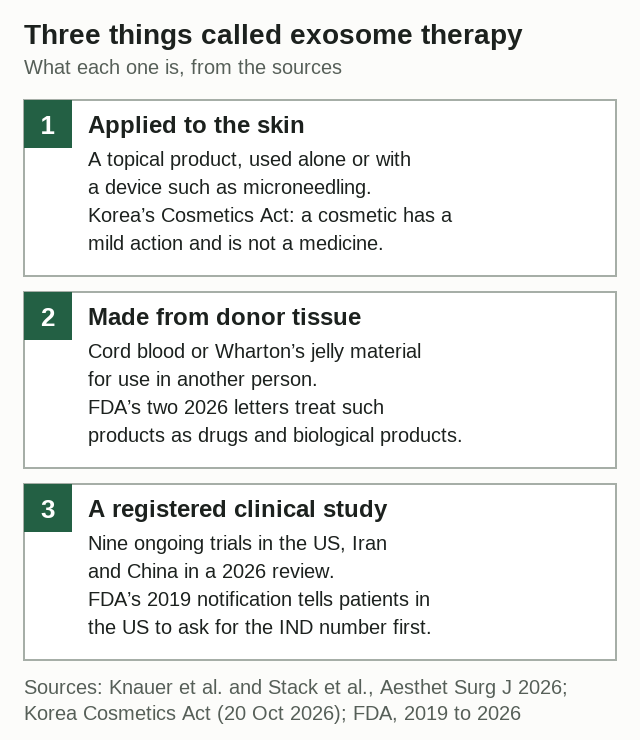
Evidence levelBy modality“Exosome therapy” is used for three different things: two kinds of product, one applied to the skin, alone or with a device such as microneedling, and one made from donor tissue for use in another person, the kind described in FDA warning letters dated 15 August 2025, 26 May 2026 and 14 August 2026; and registered clinical research. Two 2026 reviews counted 39 human studies of aesthetic uses and 18 studies of topical exosomes. Before paying for a product, get three facts in writing: where the material came from and how it was isolated, which product category it falls under where you are treated, and, if the treatment is described as part of a study, its registration number. For a named product and lot, the five records to ask for about an exosome product go further.
Three things called exosome therapy
The word on a menu, a box or a vial does not say which of the three is meant, and each one leaves a different record behind. Knowing which kind you are looking at decides what to ask for.
1. Applied to the skin
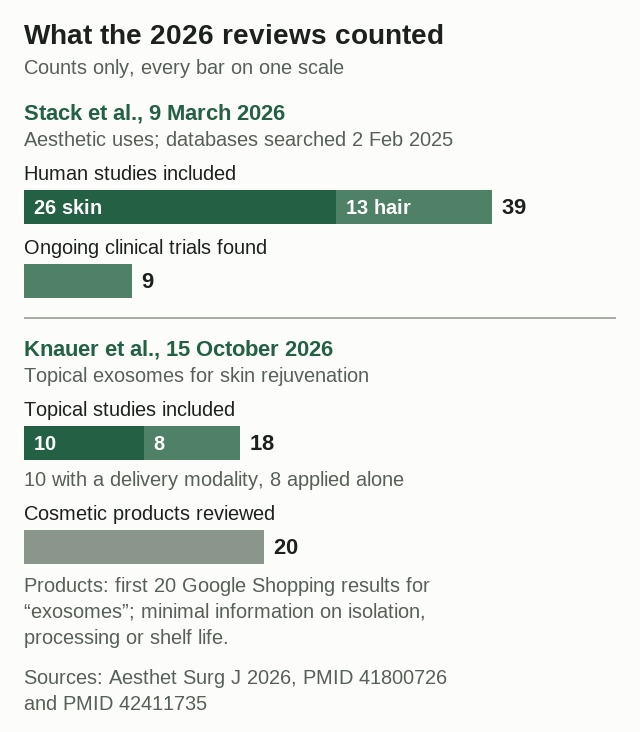
The first kind is a product put on the skin. A scoping review in Aesthetic Surgery Journal, published on 15 October 2026, found 18 studies of topical exosomes for skin rejuvenation, made from human and plant sources: 10 used a delivery modality alongside the exosomes and 8 used topical application alone. In a 2023 split-face trial, for example, an exosome-containing solution was applied with microneedling on one side of the face and saline with microneedling on the other. The combination with radiofrequency devices has its own literature, summarised in RF microneedling combined with topical exosome products.
In Korea, Article 2(1) of the Cosmetics Act defines a cosmetic as an article applied, rubbed, sprayed or used in a similar way on the body to clean or beautify it, or to maintain or improve the health of skin and hair, whose action on the body is mild; anything that is a medicine under the Pharmaceutical Affairs Act is excluded. The same 2026 review also looked at the first 20 cosmetic products in a Google Shopping search for “exosomes” and found minimal information on how the exosomes were isolated or processed, or on shelf life.
2. Made from donor tissue for use in another person
The products in FDA’s recent warning letters were of this kind: marketed for allogeneic use, meaning use in a person other than the donor, and, where a letter names the source, made from umbilical cord blood or Wharton’s jelly, the tissue of the umbilical cord. The two 2026 letters state that the products they cover are drugs under the Federal Food, Drug, and Cosmetic Act and biological products under the Public Health Service Act. A product’s category in Korea is a separate question from its US category; the Korean framework for regenerative medicine is set out on its own page.
3. A registered clinical study
The third kind is research. Stack and colleagues, who searched Medline, Embase, Cochrane, the Trip Database and ClinicalTrials.gov on 2 February 2025, identified nine ongoing clinical trials of exosome therapies for aesthetic uses, in the United States, Iran and China. A study has a registration record that anyone can look up, and how to read a trial registration record explains what it contains. For treatment in the United States, FDA’s 2019 safety notification tells patients to ask the clinical investigator for the investigational new drug (IND) number before treatment.
What the 2026 reviews counted
The systematic review and meta-analysis by Stack and colleagues (Aesthetic Surgery Journal, 9 March 2026) covers human clinical studies of exosomes in aesthetic medicine. It included 39 studies: 26 on skin outcomes and 13 on hair outcomes. The authors write that heterogeneity and non-standardised protocols limit how far the results generalise, and the journal lists its level of evidence as 3.
Knauer and colleagues screened 2,394 articles and kept 18 that tested topical exosomes for skin rejuvenation. They conclude that human studies of topical exosomes remain scarce, and that much of the current evidence is extrapolated from preclinical models.
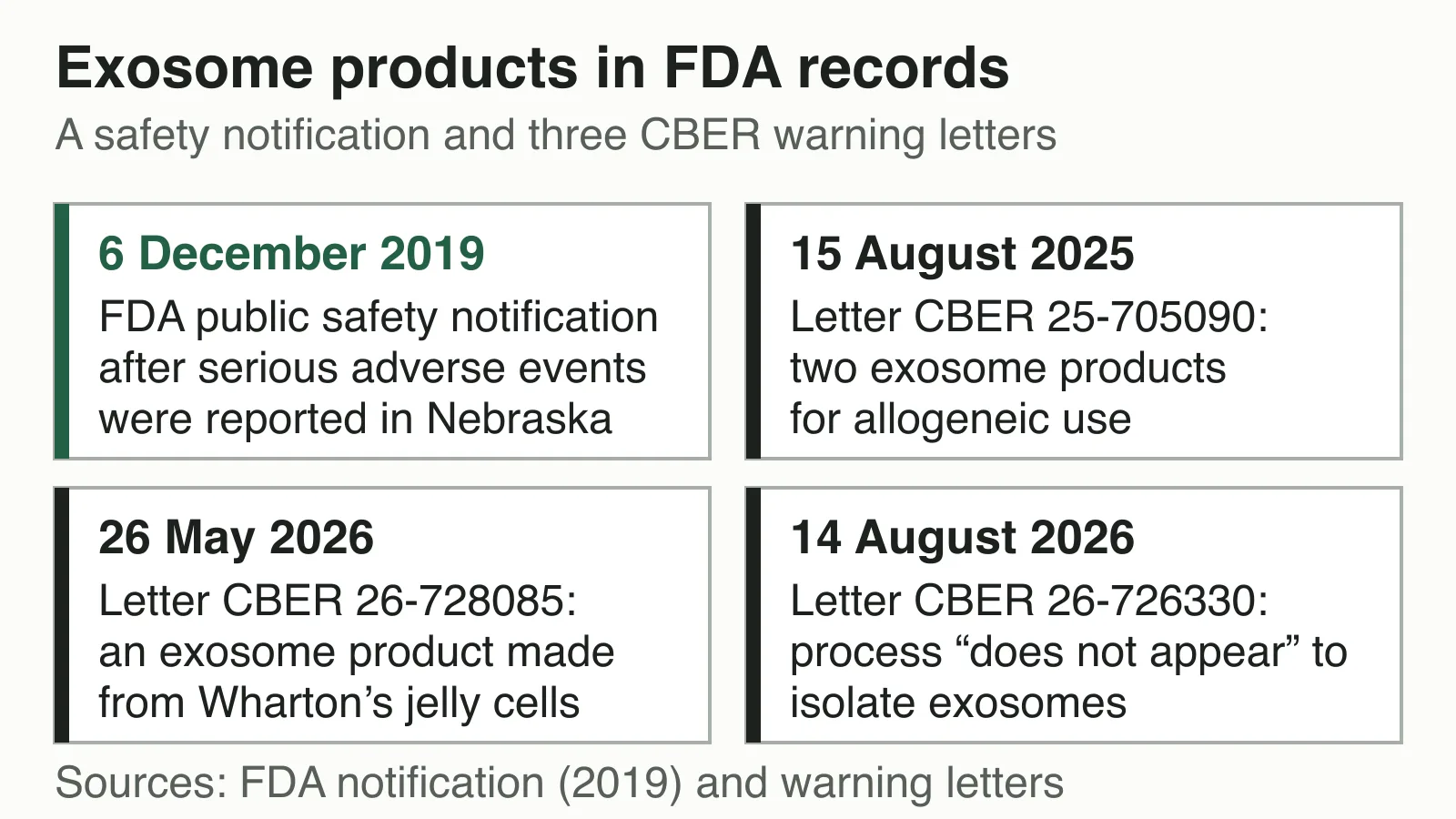
What FDA has put on record since 2019
- 6 December 2019: FDA issued a public safety notification on exosome products after “multiple recent reports of serious adverse events experienced by patients in Nebraska” who had been treated with products marketed as containing exosomes.
- 15 August 2025: warning letter CBER 25-705090 covers two exosome products for allogeneic use and refers to the 2019 notification.
- 26 May 2026: warning letter CBER 26-728085 covers an exosome product made from Wharton’s jelly cells and a cord blood product, both for allogeneic use, and refers to the 2019 notification.
- 14 August 2026: warning letter CBER 26-726330 covers products made from umbilical cord and cord blood, some marketed as exosome products. It states that several fail the criterion that they be “intended for homologous use only”, and its footnotes say the manufacturing process “does not appear” to isolate exosomes.
FDA’s warning letter search finds each letter by its reference number.
Frequently asked questions
Is exosome skin care the same as exosome therapy made from donor tissue?
No. Exosome skin care is a topical product; under Korea’s Cosmetics Act a cosmetic has a mild action on the body and is not a medicine. Products made for use in another person are what FDA’s 2025 and 2026 warning letters describe, and the two 2026 letters treat them as drugs and biological products.
What did the August 2026 FDA warning letter say about exosomes?
Warning letter CBER 26-726330, dated 14 August 2026, covers products made from umbilical cord and cord blood, some of them marketed as exosome products. Its footnotes say the manufacturing process “does not appear” to isolate exosomes, and the letter states that the products are drugs and biological products under US law.
How many human studies of exosomes in aesthetic medicine are there?
A systematic review published on 9 March 2026, with databases searched on 2 February 2025, included 39 human studies: 26 on skin and 13 on hair. A scoping review published on 15 October 2026 found 18 studies of topical exosomes for skin rejuvenation. The first review describes heterogeneous, non-standardised protocols.
Primary sources
- FDA: Public Safety Notification on Exosome Products. Issued 6 December 2019; reports of serious adverse events in Nebraska and questions for patients.
- FDA: Warning letters search. Letters CBER 25-705090 (15 August 2025), CBER 26-728085 (26 May 2026) and CBER 26-726330 (14 August 2026).
- Korea: Cosmetics Act, Article 2 (definitions). Article 2(1), version in effect from 20 October 2026 (Act No. 22113).
- Stack ER, Spongberg C, Braud SC, Stanton WN, Elway M. Clinical advances in exosome-based therapies for aesthetic medicine: a systematic review and meta-analysis of human clinical trials. Aesthet Surg J. 2026;46(12 Suppl 2):S13-S25. PMID 41800726 · doi:10.1093/asj/sjaf178. Study and trial counts.
- Knauer G, Chang A, Gupta A, et al. Clinical evidence and commercial landscape of topical exosomes for skin rejuvenation: a scoping review. Aesthet Surg J. 2026;46(11):NP148-NP157. PMID 42411735 · doi:10.1093/asj/sjag141. Topical studies and the 20-product labelling review.
- Park GH, Kwon HH, Seok J, et al. Efficacy of combined treatment with human adipose tissue stem cell-derived exosome-containing solution and microneedling for facial skin aging: a 12-week prospective, randomized, split-face study. J Cosmet Dermatol. 2023;22(12):3418-3426. PMID 37377400 · doi:10.1111/jocd.15872. Microneedling as the delivery device.
Related guides: how exosomes differ from the cells that release them, what FDA has published on stem cell and exosome products and safety and risks.