PRP and polynucleotides — the better-studied end of the category
These two are grouped with stem cells and exosomes by marketing, and separated from them by evidence. PRP for androgenetic alopecia has multiple independent meta-analyses of randomised controlled trials showing increased hair density against placebo, with the largest of them grading that evidence low certainty under GRADE. PDRN has a substantial pharmacology literature describing an adenosine A2A-receptor mechanism and use in impaired wound healing, and polynucleotides in aesthetic use have one systematic review of nine mostly small studies. Neither is proven; both have been tested in people in ways most of this category has not.
Platelet-rich plasma
What it is
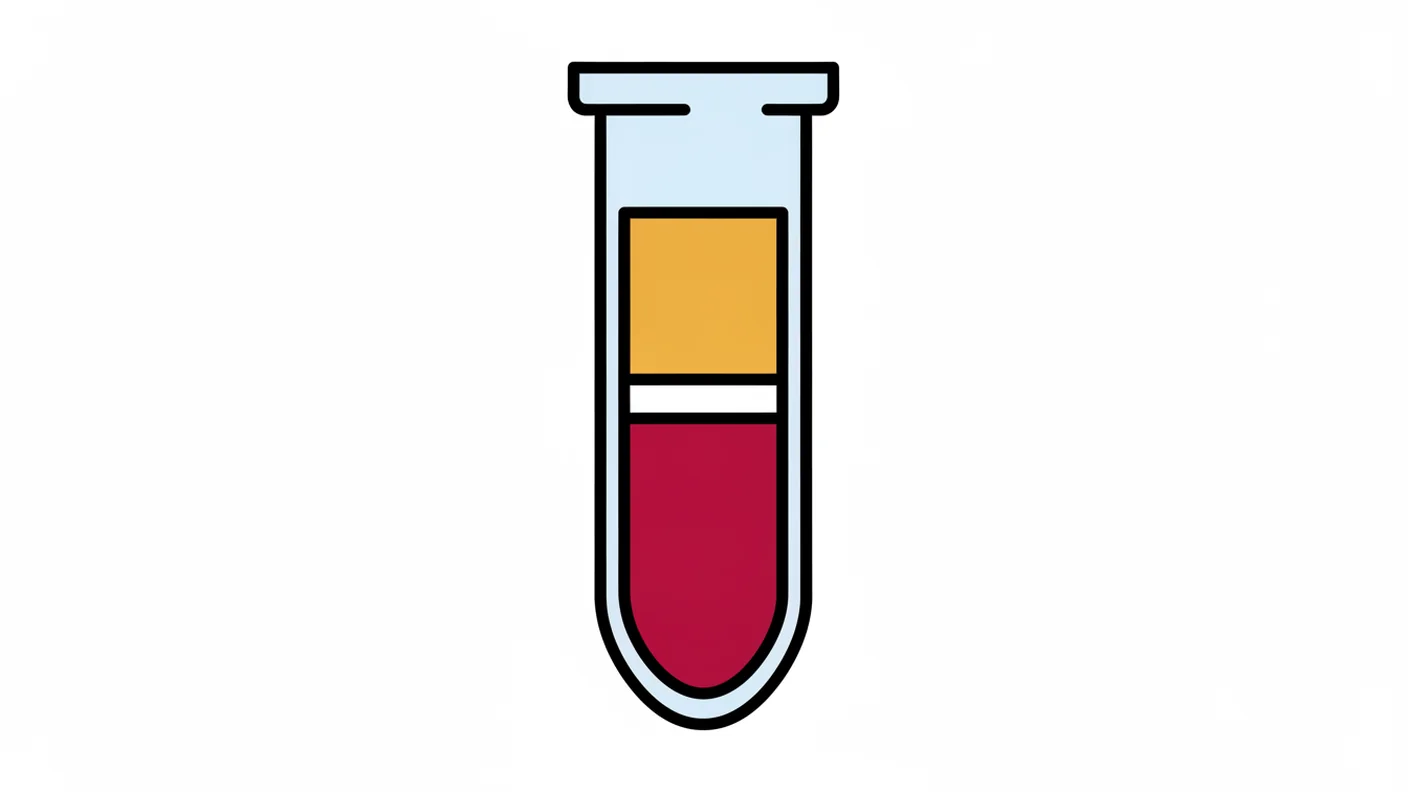
Plasma
The large upper volume after spinning.
Platelet-rich layer
A thin band. This is what is drawn off and injected.
Red cells
The dense lower fraction, discarded.
The point: Platelets are anucleate cell fragments. PRP contains no stem cells, and preparation protocols vary between studies and between clinics.
Blood is drawn from the patient and centrifuged so that platelets concentrate into a small volume of plasma, which is then injected. Platelets are anucleate cell fragments that release growth factors when activated. PRP contains no stem cells, and describing it as a stem cell treatment is simply an error of fact.
Preparation is not standardised. Studies differ in whether the platelets are activated, in centrifugation protocol, in final platelet concentration and in injection schedule, a heterogeneity the systematic reviewers name explicitly as a limit on pooling results[1]. Two clinics offering “PRP” may be delivering measurably different preparations.
What the trials found
The most comprehensive synthesis identified 27 controlled trials covering 1,117 subjects across androgenetic alopecia and alopecia areata. Against saline injection, PRP increased hair density over medium-term follow-up by a mean difference of about 25.6 hairs per square centimetre. The reviewers rated that evidence low quality under GRADE, citing inconsistency and risk of bias, and reported no serious adverse events in either arm[1].
A meta-analysis restricted to nine randomised controlled trials in 238 patients with androgenetic alopecia found statistically significant increases in hair density against placebo at three and six months; hair count and hair diameter improved relative to baseline but not significantly relative to placebo[2]. In female pattern hair loss specifically, a meta-analysis of seven studies found increased terminal hair density without a significant increase in hair thickness, and its authors recommended caution pending replication in larger and more representative samples[3].
How to read that
Consistently: density improves, other measures are less consistent, and the reviewers decline to overstate it. It is also worth keeping the comparator in view. Reviews of androgenetic alopecia treatment identify topical minoxidil, oral finasteride and low-level light therapy as the FDA-approved options, with PRP among the alternatives that lack that status[4]. A discussion that reaches PRP without having addressed the approved options has skipped a step.
PDRN and polynucleotides
What they are
PDRN (polydeoxyribonucleotide) is a mixture of deoxyribonucleotides with molecular weights in a defined range, produced from salmon DNA through a controlled purification and sterilisation process designed to eliminate active protein and peptide content that could provoke an immune reaction. Its proposed mechanism is engagement of the adenosine A2A receptor, together with supply of nucleosides and nucleotides to the salvage pathway[5]. A review of its application in skin regeneration describes effects on cell migration, angiogenesis and inflammation across in vitro, in vivo and clinical wound-healing studies[6].
“Polynucleotide” is the broader term now widely used in aesthetic practice. It is important not to assume PDRN’s pharmacology transfers wholesale to every product marketed under the polynucleotide label: the mechanistic literature was built on PDRN specifically, and source material, molecular weight distribution and manufacturing differ between products.
What the aesthetic evidence shows
A systematic review published in 2024 identified nine studies of low and moderate quality covering 219 patients receiving polynucleotide treatment. It reported promising outcomes in reducing wrinkles, improving skin texture and enhancing elasticity, with statistically significant results in several studies, side effects generally mild and transient, and moderate-to-high patient satisfaction, alongside substantial variation in injection areas and technique and limited consensus on optimal use[7]. A parallel review of current practice reached a similar position, noting varying degrees of reported efficacy and the need for further research to establish optimal use[8].
What is not established
Three things get quoted with more confidence than the sources support. There is no established universal session count or interval for either modality: the reviews describe heterogeneous schedules, not a consensus one. There is no established duration of benefit; the trials report outcomes at defined follow-up points, typically three to six months, and say nothing about what happens after. And there is no established comparative ranking between PRP, polynucleotides and the approved treatments for any given indication, because the head-to-head trials that would establish one have largely not been done.
References
- Cruciani M, Masiello F, Pati I, Marano G, Pupella S, De Angelis V. Platelet-rich plasma for the treatment of alopecia: a systematic review and meta-analysis. Blood Transfus. 2023;21(1):24-36. doi:10.2450/2021.0216-21 · PMID:34967722
- Zhang X, Ji Y, Zhou M, et al. Platelet-Rich Plasma for Androgenetic Alopecia: A Systematic Review and Meta-Analysis of Randomized Controlled Trials. J Cutan Med Surg. 2023;27(5):504-508. doi:10.1177/12034754231191461 · PMID:37533146
- de Oliveira AFQ, Arcanjo FPN, Rodrigues MRP, Rosa e Silva AA, Hall PR. Use of autologous platelet-rich plasma in androgenetic alopecia in women: a systematic review and meta-analysis. J Dermatolog Treat. 2023;34(1):2138692. doi:10.1080/09546634.2022.2138692 · PMID:36264022
- Nestor MS, Ablon G, Gade A, Han H, Fischer DL. Treatment options for androgenetic alopecia: Efficacy, side effects, compliance, financial considerations, and ethics. J Cosmet Dermatol. 2021;20(12):3759-3781. doi:10.1111/jocd.14537 · PMID:34741573
- Squadrito F, Bitto A, Irrera N, et al. Pharmacological Activity and Clinical Use of PDRN. Front Pharmacol. 2017;8:224. doi:10.3389/fphar.2017.00224 · PMID:28491036
- Galeano M, Pallio G, Irrera N, et al. Polydeoxyribonucleotide: A Promising Biological Platform to Accelerate Impaired Skin Wound Healing. Pharmaceuticals (Basel). 2021;14(11):1103. doi:10.3390/ph14111103 · PMID:34832885
- Lampridou S, Bassett S, Cavallini M, Christopoulos G. The Effectiveness of Polynucleotides in Esthetic Medicine: A Systematic Review. J Cosmet Dermatol. 2025;24(2):e16721. doi:10.1111/jocd.16721 · PMID:39645667
- Lee KWA, Chan KWL, Lee A, et al. Polynucleotides in Aesthetic Medicine: A Review of Current Practices and Perceived Effectiveness. Int J Mol Sci. 2024;25(15):8224. doi:10.3390/ijms25158224 · PMID:39125793
Bibliographic records retrieved from PubMed (U.S. National Library of Medicine). Citation here indicates the source of a statement, not endorsement by its authors of any clinic or product.
Written by the Stem Cell Seoul editorial team and medically reviewed by a Korean Board-Certified Dermatologist (AAD International Fellow · ASLMS member). Last reviewed 2026-08-30. Editorially updated 2026-09-29.